
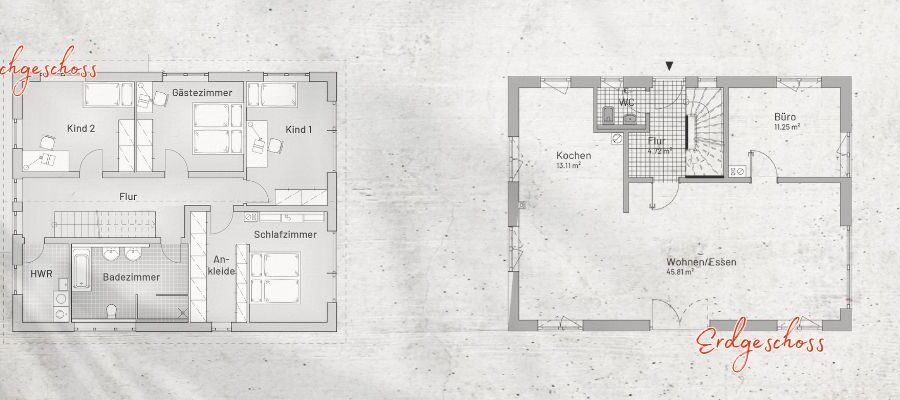
The development plan, also abbreviated to Plan B, regulates the type of use and permissible development of the properties. The legal basis is Article 9 of the Building Code (BauGB) and the currently valid version of the Building Use Ordinance (BauNVO). The development plan is drawn up and published as a legally binding statute by the respective city or municipality. You will then be able to freely view the development plan at the building authority of your city or municipality, providing the field and property number.

The development plan serves as the basis for the building permit. The owner of the property is responsible for compliance and correct execution, not the construction company. As regards the question of whether building projects which do not comply with the provisions of a development plan can also be approved, the competent building authority has a certain margin of discretion. For the rest, the development plan applies without restrictions.
Formally, a development plan consists of two parts. On the one hand, this is a plan drawing of the building area with information, for example, on the permitted orientation of the ridge, the number of parcels, the property boundaries, the delimitation between different types of use, building lines, building boundaries or building bans. The development plan instead contains a textual part that integrates and explains the graphic specifications of the planimetric drawing.
As regards the level of regulation, a distinction is made between a simple development plan and a qualified development plan. With a simple development plan, only a few requirements need to be met to obtain a building permit, such as the type of intended use. In the case of a qualified development plan, the planned building project must at least meet the requirements relating to the type and extent of structural use, building areas and local traffic zones to be approved.
TYPE OF USE OF THE BUILDING
Structural use type concerns how an area can be used structurally. As regards land use, a distinction is essentially made between residential building areas (W), mixed building areas (M), commercial building areas (G) and special building areas (S). For private house builders only residential development areas and mixed development areas are relevant.
In the development plan, residential areas are divided into four categories. WS stands for small out-of-town settlements linked to farms. Purely residential areas in which other structures are only possible in absolute exception may be marked with the acronym WR. In general residential areas (WA), residential use prevails; In exceptional cases, public facilities and commercial activities, hotels or offices may be approved without interruption. WB stands for special residential area, which is a mixed area where living is the main focus, but many other types of buildings are permitted.
In mixed areas, housing is not the only priority. However, it must not be significantly compromised by other uses. The development plan also includes four categories for mixed areas. In areas of mixed villages (MD) special attention is paid to the interests of agricultural and forestry enterprises. MI stands for mixed areas where everything except industry is allowed, but restaurants and nightclubs are only allowed in commercial areas. In the central area (MK), in addition to apartments, there are mainly commercial activities, central facilities for business, administration and culture. The acronym MU refers to urban areas in which everything is allowed that does not significantly compromise residential use. It may also be established that the ground floors cannot be used for residential purposes. For neighboring properties not built in mixed zones, find out in advance what use is permitted there so as not to have unpleasant surprises later.
EXTENSION OF STRUCTURAL USE
The scope of use of the building that can be approved is expressed in key figures. For residential use, key figures may limit the height, number of full floors and floor area of the house as well as the built-up area of the property.
The floor area number (GRZ) indicates the maximum proportion of the property’s surface area that can be developed. A GRZ of 0.3 means that a maximum of 30% of the property can be developed. According to the current BauNVO of 1990, all structures including accessory structures such as garages and terraces count as floor space. However, adjacent structures may exceed the permitted floor area by up to 50%, but not more than the 0.8 limit, unless otherwise indicated in the development plan.
The maximum permitted area of all entire floors in relation to the size of the property can be obtained from the floor area number (GFZ). With a GFZ of 0.4 you get a permitted area of 160 m2 on a plot of 400 m2. The walkable surface area is to be determined based on the external dimensions of the entire floors. According to § 20 BauNVO, the development plan may specify that the areas of rooms common to other floors, including the stairwells belonging to them and including the surrounding walls, must be included in whole or in part or, in exceptional cases, not be included. Balconies or terraces are not taken into consideration by the GFZ.
The number of entire floors allowed in a building area is indicated in the master plan with a Roman numeral. “II” means that a building can have a maximum of 2 full floors. If the Roman numeral is in a circle, it is necessary to respect the number of whole floors. What is a full floor is defined in the respective state building codes.
Height dimensions can be indicated in the form of ridge height (FH, = highest point of the house) or eave height (TH, = intersection of the facade with the roof cladding, i.e. approximately the height of the eave) with Arabic numerals in meters. Again it is necessary to respect the numbers in a circle. Otherwise these are maximum dimensions. The reference value for height dimensions is usually street level.
FURTHER CONSTRUCTION NEEDS IN THE DEVELOPMENT PLAN
In addition to the type and extent of structural use, the development plan may also specify specifics regarding the location and orientation of a home on the property. Here we need to distinguish between the building boundary, which encloses an area on which the building can be built anywhere, and the construction line, which defines the exact position of the external wall of a building. The building boundary is graphically represented in the master plan as a line with two dashes followed by a dot. You can recognize the construction line by two dots followed by a line. If building boundaries are specified, outbuildings such as garages or sheds may also be located outside the marked area.
There are two basic categories of construction, open construction (o) and closed construction (g). In the case of open construction with single-family houses (E) or semi-detached houses (D), your house must comply with a lateral limit distance, which is usually defined in the respective state building regulations. In closed constructions, for example in terraced houses (R), the external walls of the buildings touch each other on the adjacent properties.
Furthermore, in the development project you can specify the direction of the roof ridge with a double arrow and the roof pitch (DN) with a degree (e.g. 30°). Roof specifications can get to the point that the shape of the roof, e.g. SD for a gable roof or FD for a flat roof are also specified, as well as the color of the roof covering.
Planting specifications may also be included in the development plan. A small solid circle within a larger circle indicates an existing tree that needs to be preserved. If the circle is not filled, a tree must be planted in that spot.
If there is any doubt about existing requirements, the responsible building authority will provide information. Your regional construction partner will also be happy to help you understand the plans and/or submit a preliminary construction application to see if the dream home you are designing is actually eligible for approval on your property.
WHAT IF THERE IS NO DEVELOPMENT PLAN?
Especially in residential areas built before 1960 and where vacant lots are being released, the municipality does not necessarily have a development plan. In these cases Article 34 BauGB is relevant. The paragraph states that the planned home must build on existing neighboring development. This wording leaves a lot of flexibility for building permits. In this regard, in these cases it is certainly advisable to submit a preliminary building survey to the relevant building authority to explore the options.
The preliminary construction request can be formal or informal. In the case of an informal application, only the floor plan and sketches of the planned construction project are usually submitted. The formal preliminary construction request is more extensive and costs more. In this case the decision of the building authority is legally binding, whereas the response to an informal preliminary building investigation has no binding effect.
latest posts published

Elegance and versatility for your table

Plant shelf: transform your interior!

creative tips for your stay

Comfort and style at home
mix styles and dishes!

Transform your interiors with elegant pastel colors

Give a unique Boncoeurs gift

Olfactory elegance: reinvent your interiors

Brighten up your windowless space: effective tips