
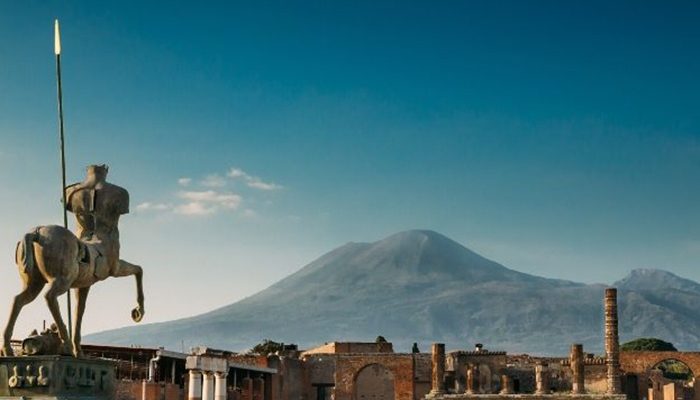
The biblical verses of Pompeii, daughter of Vesuvius, there is no Bible for Pompeii or Herculaneum, but there is a possible correspondence between the Holy Scriptures and the catastrophic eruption of Vesuvius in 79 AD Could it be God’s wrath on the sinful city or simply a terrible geological event? And what is the next step?
«If you follow my laws…, I will send you rain in due season, the earth will bear its fruit, and the trees of the field will bear their fruit
Thus begins the history of the ancient city of Pompeii, founded at the foot of a volcano, probably in the century. 8 BC and became a Romanian city in 80 BC. Colonized since the Bronze Age, the fertile area at the mouth of the Sarno river, fattened by the lava released from the ancient eruptions of Vesuvius, allows the development of prosperous agriculture, especially for the cultivation of olive trees and vines. name Pompeiiit seems comes from of the “pump”, or procession commemorative in honor of Hercules’ victory over the giants. Furthermore, the city of Herculaneum, located nearby, takes its name from Hercules, thus certifying the legend of the hero’s victory in a fiery landscape. Translated into pragmatic language, the legend offers clues to possible eruptions, because where else could the landscape of fire appear in an area rather dominated by water? Beyond the legend and retracing the periods of presence of the Greeks and Etruscans, we record that Pompeii claims its Samnite origins, of the local population, independent of the Roman authority, which it opposed until 80 BC. when Silla will definitively establish it. A period of constant prosperity follows. An important port on the Gulf of Naples, the city becomes an elite center for the trade of olive oil, wine, wool, salt, vegetables, exotic fruit, wheat, spices, marine products. Everything bears fruit and develops, until that day in August 79 AD
Precious treasures and oil are in the house of the wise man, but the foolish man squanders them.
The Pompeii of those times looks like a typical Roman city, surrounded by walls and equipped with 2-3 entrances under the porticoes. Stone flooring in a certain sense polygonalplaced at a corner, to allow rainwater to drain, created by natural stone tiles the volcano covers the streets and roads. On some streets the traffic is one-way. The city is a complex of arrogant villas (Nero himself has one here!), temples, baths, schools, water towers, small sanctuaries for various deities, public fountains (about 40) and more modest houses. Everyone talks about a thriving community. The villas, some from the 2nd century BC, also respect the typical constructions of the time: directly from the street, through a small door, you enter a corridor that opens into an atrium with columns and which has a rectangular water basin, without a roof. From the atrium you pass to other rooms: a bedroom, a dining room, a room for the cult of ancestors.
On the internal floors there are grandiose mosaics full of mythological scenes or which tell the concerns of the owners. In gardens paved with Red Lava decorative mosaic or similar ornamental fountains in thrones, statues, pergolas, canopies. Murals cover the surrounding walls external flooringgiving the illusion of landscapes, sometimes emphasizing the status of the character eating in front of the painting. The slaves, on the other hand, live as if in a prison and, together with the houses where the prostitutes work, reveal the other face of the city. Among the buildings that stand out is Pompeii Amphitheaterone of the oldest and best preserved in the world, (older than the Roman Colosseum). This, along with external flooringthey are the city’s coat of arms. Everything flourishes and develops until that August day in 79 AD
«I have one thing against you: that you have abandoned the love you had before. Therefore remember from where you have fallen, repent and do the works you did before. If not, I will come to you and remove your lampstand from its place, if you do not repent… (Biblical Revelation 2:1-29)
On 5 February 62 AD a devastating earthquake (7.5 degrees on the Richter scale) occurred and damaged many houses in Pompeii, buildings of all kinds collapsed, including pieces of the defensive walls. The water system is seriously compromised, the bridge over the Sarno river also collapses. Thousands of deaths pay the price of enriched lives, but are these lives still close to faith? Those who understand the message quickly leave the city, there are enough of them to rebuild it. Spurred by the visit of Emperor Nero, the repair work is accelerated and, it seems, life resumes its course. The residents do not interpret the call and return to their old habits. Everything is restored and abundance returns to the city, until that August day in 79 AD
Truly I say to you: on the day of judgment it will be easier for the land of Sodom and Gomorrah than for that city. (Bible Matthew 10:14-15)
Suddenly, in the summer of 79 AD, strange things happen to the cities of Pompeii and Herculaneum. The Sarno river fills with dead fish, the springs and fountains dry up, the vines on the coasts of Vesuvius dry up quickly, more and more earthquakes are felt in the cities. As a result people start leaving the city»for whoever calls on the name of the Lord will be saved(Romans 10:13), but most remain, they will see the apocalypse with their own eyes.
On the morning of August 24, 79 AD, Vesuvius’ thousand-year sleep ended suddenly, fatally. The angry volcano begins to spit fire and smoke, like a mythological dragon brought back to life from the depths. In broad daylight, a huge explosion is heard that pulverizes the volcano’s crater and launches a cloud of particles from the Ponce Stone into the sky, raising it to a height of 43 km (it seems that the maximum height to which a military plane has risen is only 37.5 km). To imagine the power of the explosion we refer to the Hiroshima bomb. The force of the artificial bomb, which killed an entire city in the 20th century, is negligible compared to the force of the volcano 2000 years ago. which has been calculated to be 100,000 times stronger.
“Truly I tell you, not one stone upon another will remain here that will not be thrown down.” (Matthew 24:11-51)
“And you will know the truth, and the truth will set you free.”(John 8:32)
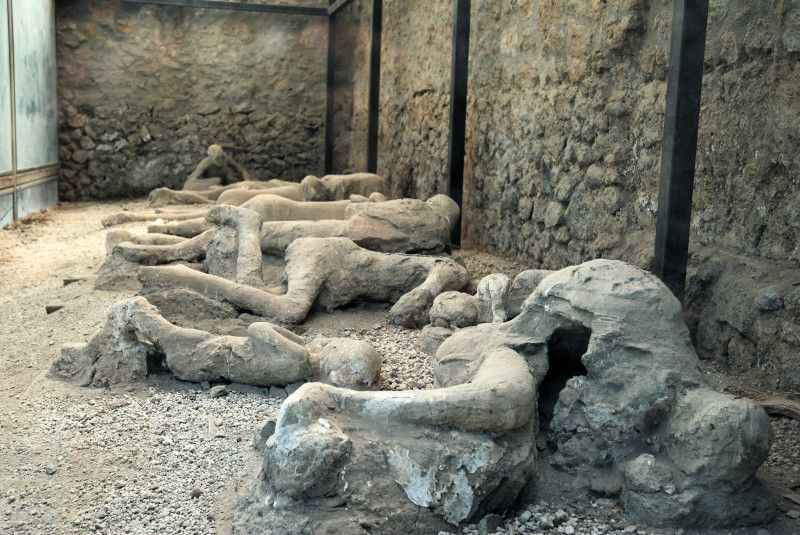
The first light ash settles on Pompeii, centimeter after centimeter. People run away, hide, unconsciously the volcanic material swallows the city. At the end of the afternoon, another explosion hurled a column of ash and pumice even higher than that of the first eruption. Falling ash now comes in the form of stones heavy, some buildings collapse, people hide where they can. At 11pm, the cloud above the volcano collapses on the city, 6 successive waves of ash and hot air pour over the city, suffocate and cook everything alive in a few moments. The hot, nasty matter continues to fall, burying the city. Under meters of ash it is practically erased from the face of the earth. Just like Herculaneum. Lost and forgotten, Pompeii and Herculaneum lay under punishment for several centuries.
“Just like Sodom and Gomorrah and the surrounding cities…subject to the punishment of eternal fire.” (Jude 1:7)
«Do not judge, lest you be judged. For with the judgment you give you will be judged, and with the measure you use it will be measured to you.» (Bible Matthew 7:1-5)
Since then, studies of all kinds and a flurry of controversies have attempted to shed light on the catastrophe. The first controversy concerns the date of the eruption, traditionally 24 August 79 AD, in reality it seems to have been between mid-September and the beginning of November, the latest version circulating would be 17 October. Since 1755, when work began on the construction of the Sarno canal, extensive excavations have brought to light an entire city. Over time, famous visitors such as Goethe, Mozart or Stendhal underlined the oppressive feelings they experienced. For archaeologists, the multitude of finds provides concrete data through which to reconstruct an entire era. Along with the fate of the people killed then, the number of which is estimated at between 12,000 and 30,000 souls. Among the first notes on the catastrophe are the letters of Pliny the Younger to the historian Tacitus, which describes the death of his uncle, the admiral Pliny the Elder, under the ash of the volcano, just as he was sailing to save the survivors of Pompeii.
For some specialists it is clear that the pyroclastic flows, made up of hot clouds of at least 250° C, made of ash, lava and gas, which descend at speeds of 80 km/hour, are responsible for the instant death of the people remaining in Pompeii and Herculaneum. Recent studies by other specialists reveal the decisive role of heat which, rising to around 300°C, alone has caused the death of most people. Their corpses and those of the animals were found under 6 meters of successive pyroclastic materials (tephra). Each of them shows the exact moment in which they were reached by the heat that cooked them, literally, in the most different positions and attitudes.
Conclusions nowadays:
most likely the cumulative effects of the eruption led to the death of the inhabitants. Currently in Europe there are several volcanoes with reduced activity, among these: Vesuvius, Etna (Italy), Santorini (Greece), Teide and La Palma (Canary Islands), Eyjafjallajökull (Iceland). The latest eruption to date is that of the La Palma volcano (Canary Islands), recorded on 19 September
latest posts published
Elegance and versatility for your table

Plant shelf: transform your interior!

creative tips for your stay

Comfort and style at home

mix styles and dishes!

Transform your interiors with elegant pastel colors

Give a unique Boncoeurs gift

Olfactory elegance: reinvent your interiors

Brighten up your windowless space: effective tips