
Perhaps the most famous megalithic structure is Stonehenge (England). Is she the only one?
But what are megaliths? And how did they appear? How could these stone megastructures be made and how were the enormous blocks lifted and transported in a time when technology was at an ultra-primitive level?
This article is intended to introduce you to a world that remains mysterious and indecipherable even to the most enlightened minds.
What are megaliths?
Megaliths are stone colossi, generally with a low level of workmanship, used, alone or in groups, for the construction of monuments, most likely religious, in prehistoric architecture.
From the single stone (menhir) to the sets mounted together with the «dry» technique, without mortar, megaliths are forms of rock art organized most often for religious purposes, of cultures whose technologies still remain inexplicable to us. The most famous structure is the dolmen, a funerary monument consisting of a large piece of stone, placed horizontally on other stones placed vertically. Another form is the menhir (men = stone; hir = long, in Breton), it was made up of a single stone, large and placed in a vertical position. Several menhirs were arranged in (semi)circular and ellipsoidal shapes (Stonehendge, Avebury and Ring of Brodgar all in Britain) or in parallel lines (Carnac Stones in France).
The meanings of these forms are not yet fully clarified, especially in the context in which they overlap with other forms of megalithic art, such as the over 200 decorated stones of the monumental complex of Knowth (Bru na Boinne – Ireland). Quite surprisingly, a similarity of features can be observed in the architecture, stone carvings and motifs used in the execution of tombs located at great distances, which further increases the mystery of the constructions.
How did megaliths appear?
The first apparition dates back to over 9000 years before Christ, in Gobekli Tepe (Türkiye). The monument consists of 20 circles made up of stone pillars, some with heights exceeding 5 m and 15 tons in weight and placed in the shape of the letter «T». The technology of making and assembling these colossi of the Mesolithic era, where the tools are known to have been made of flint, remains deeply buried in the dust of millennia past. Anotr outstanding Mesolithic achievement, beginning about a thousand years after Gobleki Tepe, is th famous Stonehedge complex (the pedestal pits).
After another 4000 years (around 5000 BC, already in the Neolithic), the monuments of Evora (Portugal), an ancient land occupied by the Celts, appeared, then the mound of Barnenez (France) and the temples of Skorba (Malta).
Arising for religious rather than economic reasons, these true miracles of the first millennia still agitate the minds of scientists today, in an attempt to give rational answers to the multiple questions that each of these sites poses.
Geopolymers reveal surprising technology
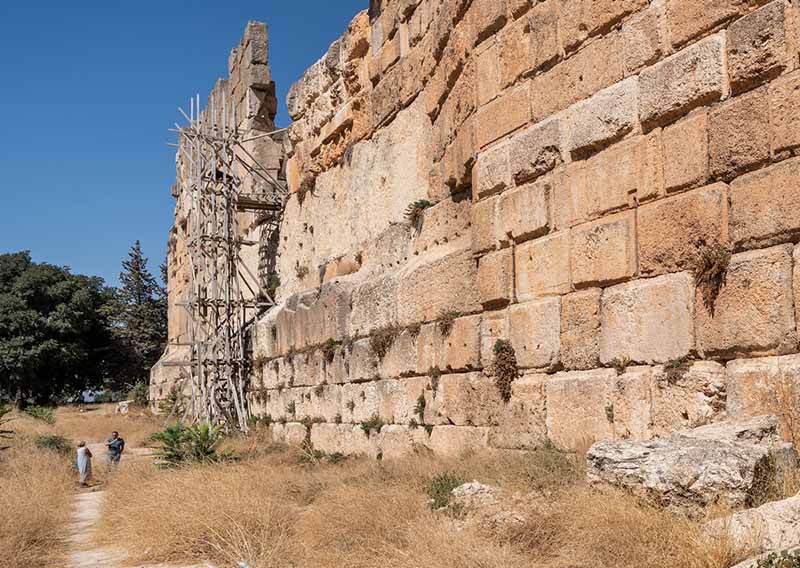
What is surprising about the construction of a megalith is not only the precision of the execution, impossible to reproduce even today, in relation to the conditions existing at the time, but also the transport of the enormous blocks, their erection and placement, which also remained unexplained.
One theory that seeks to avoid answers to questions regarding the transportation of the huge blocks and also explains the precision of their shapes, is linked to the on-site fabrication of «geopolymers». Of superior hardness, these blocks would have been made by pouring a suspension of ground limestone and water into molds. The creation of these geopolymers, obtained by solidifying the suspension in molds, is linked to limestone and natural sandstone. It is said that the «softening» of the limestone was achieved with the use of plants, as well as with andesite, another material favored by builders of the time. For South American megaliths, it is believed that «softening» acids were obtained from corn and that guano was used as a strengthening element. Reference was inevitably made to the Egyptian pyramids, but without being able to give a definitive and unanimously accepted ruling. It is certain that the experiments carried out in France, under the conditions of the local climate, led to obtaining some geopolymers in a period of 3 months. In the confusion about the categories of plants that could soften limestone or andesite, we turned to local legends that speak of plants capable of breaking down stone.
This theory, already proven, may provide a starting point for explaining one of the great mysteries of primitive technology.
What the giant of Baalbeck tells us
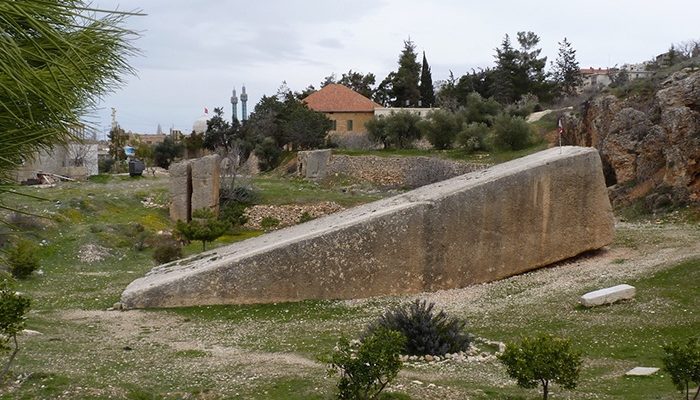
In 2014, the largest monolith in the world was unearthed in Baalbeck. With a weight of approximately 1650 tons and dimensions of 19.6 m long, 6 m wide and 5.5 m thick, it surpasses 2 other monoliths of more than 1000 tons. Was this giant made with geopolymer technology? Are the Romanians the skilled builders and capable of managing the construction and transport of the enormous block? If this were the case, then how could we explain the fact that the largest stone we know of transported by the Romanians, in decades of effort, weighs 5 times less, i.e. «only» 323 tons (the Lateran obelisk). Or perhaps they found the technology to enable them to make such a leap, impacting the endurance of carrying a block 5 times heavier than the heaviest block moved thus far. Among the multitude of theories issued by specialists without being able to give a definitive verdict, all in search of a scientific foundation, a truly surprising one stands out, based on local legends; which speak of the erection of the monument by the ancient inhabitants, who were giants.
PIATRAONLINE invites you
In an attempt to study the mysteries of natural stone through the history of PIATRAONLINE, a perpetual generator of inspiration, challenges you to an exercise of imagination.
Write us a comment on the site about your opinion, which hand do you go for? Should the explanation regarding the construction of geopolymers be sufficiently supported? Should we perhaps imagine entire generations made up of tens of thousands of people transporting stone giants to destinations chosen according to criteria known only to them? Or maybe the giants of legends are the extraterrestrials to whom the ancestors of our ancestors worshiped by erecting their temples?
What do you think?
latest posts published

Elegance and versatility for your table

Plant shelf: transform your interior!

creative tips for your stay

Comfort and style at home

mix styles and dishes!

Transform your interiors with elegant pastel colors

Give a unique Boncoeurs gift

Olfactory elegance: reinvent your interiors

Brighten up your windowless space: effective tips