The window was born from the need for light, it also allows us to see the world, as it is in that moment. Daily reality becomes relatively palpable when looking from the window, the charm of the meditative search for the present underlines our belonging to the present.
But how to see the past? And how can we bring him closer to us, to know him better, receive his vibrations and learn from him?
Spectacular innovations bring the past closer to us, special windows place virtual images of reality alongside them, offering images of the past to the eye and the spirit.
First mentioned in 1381, the construction of the fortress is attributed to Prince Lazar, then ruler of Serbia and Moravia, and the fortress served as the capital. In 1389, after the battle of Campia Mierlei (Kosovo Polje), both Prince Lazar and Sultan Murad I were killed, the outcome of the battle was tactically undecided, but in practice the penetration of Muslims into southern Europe was achieved. For us it is important because the Turks exerted great pressure on the Romanian country, at the time of Mircea the Elder. A few years later the battles of Rovine (1395) and Nicopole (1396) followed, the latter a true catastrophe for Christianity.
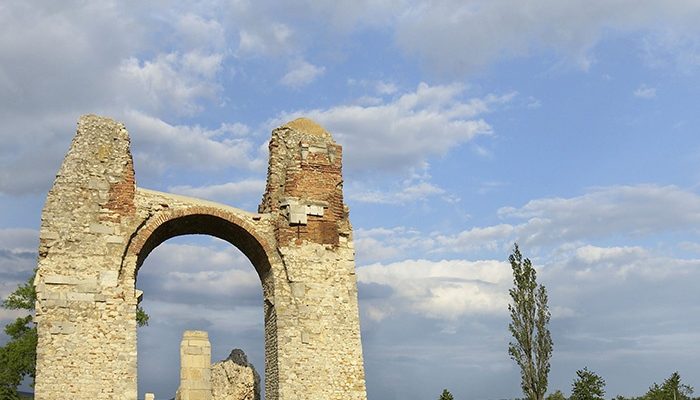
Even though the capital moved to Belgrade, the fortress of Krusevac maintained its strategic importance, being subsequently occupied by the Turks and Hungarians, returning under the control of Serbia until 1454. In that year there was the Turkish assault on Serbia led by Muhammad II the Conqueror himself, who a year earlier had become lord of Constantinople. The fortress fell, later becoming a gunpowder depot. After battles, robberies and under the inexorable seal of time, Kusevac is today a ruin. What remains of the ancient capital are the Dijon tower which guarded the entrance and a piece of the eastern city wall. This tower was covered with colored cobblestones, hence the Turkish name of the fortress: «Colorful City». Virtually today it is difficult to imagine what the fortress looked like in its best times. Today, superior technology comes to the aid of visitors, allowing them to view the fortress as it once was.
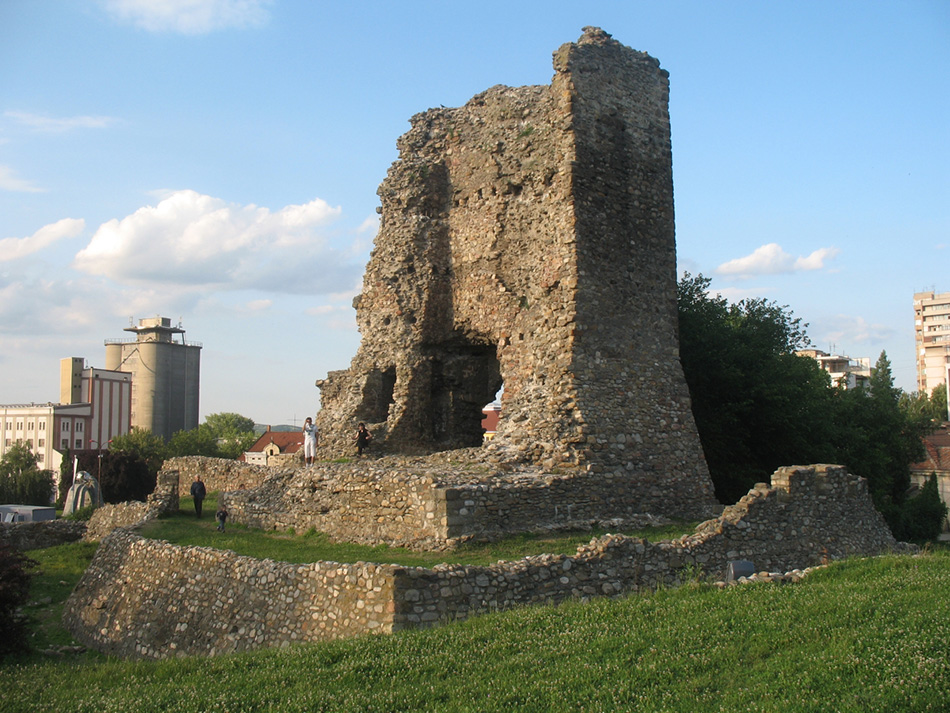
2. Heidentor (Gate of the Pagans) – Austria
Heidentor is the most famous Roman monument in Austria. It is not clear what it was for, some sources speak of a funerary monument, others consider it a triumphal arch erected in honor of a general. Legend tells of a young shepherd who, passing through the area with his flock, one evening saw a blue light rise from the ground. He dug there and, just as fear gripped him, he struck with his shovel a hard stone, on which a Roman inscription was written. He bent down to pick it up, thinking he had stumbled upon a treasure, when it was pulled up over his shoulder, looking back he saw a strange man, dressed in a black cloak and wearing a plumed hat, who said to him:
«You bastard, leave the treasure! It’s not for you! Take care of your livestock»!
While looking after the herd, the boy noticed that the cows had entered the vineyard and were tearing the meat apart. He ran to chase them away. Then looking back, he saw how the man began to grow until he became enormous and surpassed the Pagan Gate in height. Then he tore off a piece of masonry and threw it into the hole the young man had made, plugging the treasure forever. The shepherd then lost consciousness and when he regained it late, it was night around him, the stranger had disappeared, as had the guiding light, and the cattle had dispersed. He went to look for them, leaving a piece of wall behind him, stuck in the ground. Using technology similar to that applied to the Krusevac fortress, you can see the gate as it was, next to it, embedded in the ground, is the piece of wall covering the legendary treasure.
Truth or legend, the past transmits its messages to subsequent generations over time, challenging the contemporary imagination to understand them.
Write a few words, your advice is also useful to others. There are currently no comments or questions about the article.
Conclusion
Windows have always been more than simple architectural elements. From the very beginning, they were created to bring light into our spaces and to connect us with the world outside. Through a window we observe the present moment: the changing light of the day, the movement of people, the rhythm of daily life. Looking through a window often becomes a quiet and reflective act, allowing us to pause and observe reality as it unfolds before us. In this sense, windows symbolize our connection to the present and our place within the world around us.
Yet human curiosity does not stop at the present. We constantly seek ways to understand the past, to explore the stories that shaped the places we inhabit and the cultures we belong to. The desire to see beyond time, to understand how a place once looked or how people once lived, has always been part of human imagination. Traditionally, this connection to the past came through books, photographs, and historical accounts. Today, however, technology offers new and exciting possibilities.
Innovative digital tools and augmented reality systems are transforming the concept of the window itself. These new “windows” combine physical views with virtual images, allowing people to see layers of history superimposed onto the present landscape. Standing before a building, a square, or a historical site, one can now visualize how that same place appeared decades or even centuries ago. This fusion of real and virtual perspectives creates a powerful experience that connects observation with knowledge and emotion.
Such innovations do more than simply display historical images. They encourage deeper reflection about the passage of time and the evolution of our surroundings. By comparing past and present views in a single glance, people gain a better understanding of cultural heritage, urban transformation, and historical memory. The window becomes not only a tool for observation but also a bridge between different moments in time.
latest posts published
Elegance and versatility for your table
Plant shelf: transform your interior!
creative tips for your stay
Comfort and style at home
mix styles and dishes!
Transform your interiors with elegant pastel colors
Give a unique Boncoeurs gift
Olfactory elegance: reinvent your interiors
Brighten up your windowless space: effective tips