
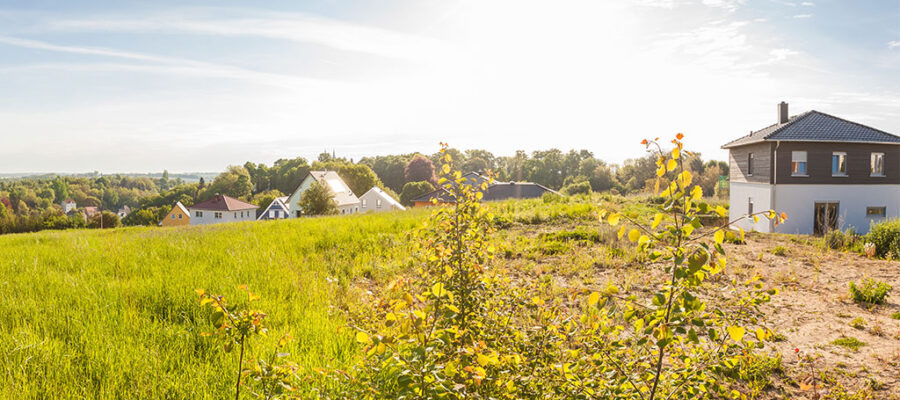
Before building your house, you need to choose the right piece of land. Unless you’ve just inherited a building plot or have the ability to build in your parents’ backyard, you’ll need to start looking for the right place for your dream home. If you follow a few important tips when purchasing a property, you will be able to purchase one without making any costly mistakes.
THE FIRST IMPRESSION

Let’s not kid ourselves. If we don’t like it the first time we see it, we can’t sugarcoat it later. This also applies to choosing the right property for your dream home. On the contrary, when choosing the right property: don’t be guided only by the first impression! If the property has wonderful views, is well laid out or is in a wonderfully quiet location on the outskirts of the city, these are clear incentives to purchase. You should feel comfortable in this place for years and decades. However, it would still be wrong to judge the property based solely on these first impressions. Before purchasing a property it is also important to check the concrete facts in order to make a decision regarding the property with a clear conscience.
THE CONDITIONS ON THE PREMISES
Is the property facing south or south-west? This offers not only plenty of sunlight during life, but also the best conditions for the solar system or photovoltaic system on the roof. What is the layout of the property? A very tortuous property imposes constraints on buildability and the impact of the house on the land. A rectangular plot of land is ideal.
If the property is located on a slope, hopefully the view of the valley and the vastness will not be obstructed. Building a house on sloping land is a bigger challenge and should be planned and built by an experienced company such as a construction partner. Standard or top-edge type houses generally do not meet the requirements of a hillside location.
If the property still has old or abundant vegetation, demolition or clearance costs must be taken into account when calculating the construction costs of the house. Old, demolished homes may be exposed to asbestos. This leads to enormous disposal costs. If in doubt, it is best to consult a specialist for an evaluation.
When making your decision, also take into account location factors such as transport links, local shopping opportunities, proximity to secondary schools or the length of your future commute. The most beautiful location becomes a burden in the long run if you have to sit in traffic for three hours a day while going to work.
SOIL CONDITIONS
The state of the land can also prove to be a cost factor that should not be underestimated. Rocky or unstable soil can quickly increase your planned home’s foundation costs by a five-figure amount. For a house designed with a basement, the height of the water table is also important. Depending on this you have to take into account the increased construction costs for adequate water protection in the basement.
If no land report is available, you must carry out a proper land survey with the seller’s consent before purchasing the property. You will still need this report for the subsequent construction of the house. In this sense the money is in no way spent in vain. Either it gives you security and is therefore included in the costs of building the house or it prevents you from making a costly mistake.
THE CONTRACTUAL CONDITIONS FOR THE PURCHASE OF THE LAND
An essential part of the purchasing decision is to review the property’s development plan, where the rules for development are set out. This shows whether your dream home can be built in the size and height you desire or whether strict specifications limit the ability to build it so that your ideas cannot be realized. If you have any doubts, your local construction partner will be happy to help. Through a preliminary construction request he can clarify whether your dream house can be built on your dream property and give you further advice on purchasing the land.
In the case of a property that has not yet been built, it should be clear with regard to the connection to the sewerage system and the nearest road whether the seller has already paid all construction costs or whether these costs must be borne by the buyer of the property. In the latter case, the costs still incurred at the time of purchasing the property must be included in the house construction budget. It would be catastrophic if the municipality had not yet decided on the development of the beautifully located dream property and had no intention of doing so in the near future.
It is also useful to read the municipality’s general planning documents. Is a ring road planned near the now idyllic property or will the unobstructed view of the countryside soon be blocked by a new building area?
The land register shows who the legal owner of the property is and whether there are any mortgages or land charges on the property. But easements towards neighbors (for example rights of way or pipelines), easements of public services or rights of habitation can also be registered in the land register. They must be checked before purchasing the property and, if necessary, their cancellation must be approved at the time of purchase. Furthermore, it is important that the seller of the property guarantees in the purchase contract that he is not aware of contaminated sites or other hidden defects.
The value of the land often serves as a guideline for the purchase price, but is not binding. The corresponding value can be viewed in each municipality so you can be sure you are paying an appropriate price for your dream property.
latest posts published

Elegance and versatility for your table

Plant shelf: transform your interior!

creative tips for your stay

Comfort and style at home

mix styles and dishes!

Transform your interiors with elegant pastel colors

Give a unique Boncoeurs gift

Olfactory elegance: reinvent your interiors

Brighten up your windowless space: effective tips