
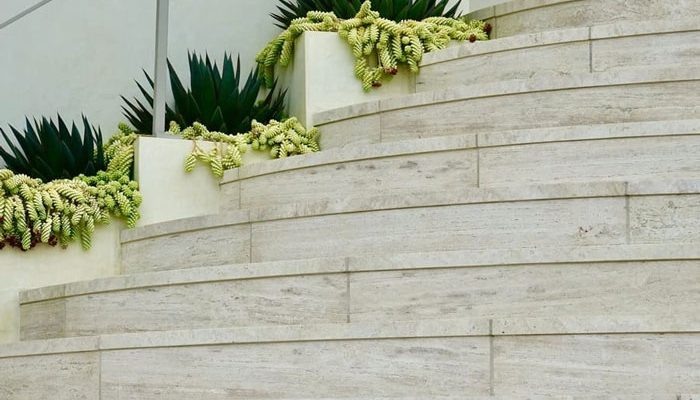
The external steps made of natural stone are elegant, but also extremely resistant over time. Whether we are talking about granite, travertine or marble, each of these types of stone has specific properties that make them an excellent choice for exteriors. Find out in this article why these types of stone are so popular, what advantages each offers and how to choose the most suitable stone for your external steps
1. Granite: the epitome of durability: durable and elegant outdoor steps
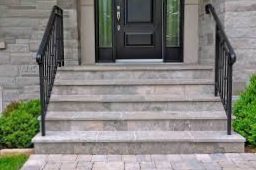
Granite is the perfect choice for outdoor steps due to its many properties. Being a volcanic rock formed by the slow cooling of deep magmas, granite benefits from a high density, varying between 2500-2800 Kg/m³ and over 2800. Its flexural strength is impressive, with average values in the range 8-16 MPa, and its compressive strength reaches average values in the range 80-150 MPa.
These characteristics make it ideal for heavy traffic areas, having excellent abrasion resistance and an average water absorption of 0.3-1 (%). Furthermore, its thermal expansion coefficient is between 5×10¯⁶ and 9×10¯⁶ (1/°C).
In addition to its exceptional durability, granite also stands out for its particular aesthetic appearance. Granite steps for the outside in a wide variety of colors and textures, offering multiple options to customize your treads. Whether you prefer a classic or modern style, granite easily adapts to any preference.
Here are some types of outdoor steps for which granite is an excellent choice:
- Steps leading to the main entrance: Granite is ideal for the main entrance staircase of a house or building, because it offers a refined and impressive appearance. Thanks to their wear resistance, they can withstand heavy foot traffic and adverse weather conditions.
- Steps for terraces or gardens: in gardens or on terraces, granite steps can integrate naturally into the landscape, having a pleasant appearance and being resistant to humidity. Granite has a natural structure that prevents slipping, being suitable for outdoor spaces exposed to rain.
- Steps for swimming pools or wet areas: Granite can also be used for steps around swimming pools or other wet areas, as long as it is properly treated or finished to prevent slipping. Versions with a non-slip finish are ideal for these applications.
- Stairs for public or commercial buildings: due to its resistance to wear and heavy traffic, granite is often used for the external steps of public, commercial or institutional buildings. It offers both a sophisticated look and long-term durability.
- Steps for service stairs or secondary stairs: granite can also be a good choice for secondary or service stairs, especially if you want a long-lasting solution that does not require much maintenance.
2. Travertine – rustic elegance: a flexible choice for outdoor steps
Travertine is a natural stone with a charming rustic appearance. It is appreciated for its varied shades, from white to dark brown, and is a great choice for any home style. Travertine steps for outdoors, it resists wear and atmospheric agents well.
But what makes travertine so special? Here are some of its main advantages:
- special beauty and special design;
- non-slip finish in warm shades;
- modular dimensions, easy maintenance and assembly.
One of the biggest advantages of travertine is its flexibility. It can be used for steps, floors, coverings or even kitchen worktops. Additionally, travertine is available in a variety of finishes, from matte to glossy, giving you the option to choose the one that best suits your style.
Recommended finishes for travertine on external steps:
- Periato (brushed): offers a slightly rough and natural texture, ideal for outdoors.
- Mat: this finish keeps the travertine slightly non-slip and avoids excessive light reflection.
- anti-slip: In areas exposed to water, the non-slip finish is essential for safety.
3. Marble: Luxury and Refinement: Transform your outdoor steps into a work of art!
Marble is a natural stone of rare beauty, capable of transforming any external staircase into a real point of reference. By its nature, marble is a metamorphic rock made up of limestone, which can be found in a wide range of colours, from pure white to intense black, passing through shades of grey, beige, pink and green. Its consistency can vary from fine to granular, depending on the processing method.
One of the main advantages of using marble for external steps is its resistance to atmospheric agents. Marble is not easily damaged by rain or snow, making it ideal for outdoor use. Furthermore, the luxurious and refined appearance adds value to the property and transforms a simple staircase into a work of art.
When you choose marble for the external stepsyou have to consider several factors:
- the color and structure of the marble it should match the rest of your home’s exterior design;
- durability and maintenance: Marble is a relatively soft natural stone compared to granite, for example, and can suffer scratches or wear over time, especially in high-traffic areas. Outdoor marble steps are exposed to dirt, gravel and other abrasive particles, so marble may require more frequent maintenance to avoid damage. It is advisable to apply a quality sealant to the marble to prevent the penetration of water and dirt and to protect the stone from degradation;
- compatibility with the architectural project: marble works very well in classic, Mediterranean or contemporary architectural contexts, but might look inappropriate in a rustic or very modern setting. Make sure that the choice of marble for the external steps is harmoniously integrated into the architectural ensemble of the house.
Care and maintenance of natural stone steps: tips and tricks
Care and maintenance of natural stone steps are mandatory to preserve their beauty and durability. Specialized cleaning and waterproofing products are the key to durable and attractive steps. So, what do you need to know about these products and how to use them?
- For travertine We recommend initial cleaning with Grimex, a product specially created to remove dirt and impurities from the surface of the stone. After cleaning, waterproofing with LTP Mattstone will protect the stone from damage.
- If you want to step it up the color of travertine and to highlight its beauty, use the LTP Color Intensifier waterproofer. For daily cleaning and maintenance, LTP Waxwash is the ideal product.
- With regard to marblethe maintenance process is similar. Start by cleaning with LTP Grimex, and for waterproofing use LTP MPG, ideal for shiny surfaces, acting without altering their appearance. LTP Waxwash is also the solution for daily cleaning and maintenance here.
For difficult stains, regardless of the type of natural stone, LTP Power Stripper is recommended. And if you’re faced with rust stains, LTP Grout Stain Remover is the solution. You can find all these products in the section cleaners for natural stone.
Choosing natural stone for external staircases is undoubtedly a long-term investment. In addition to its functionality, it adds value and style to the property, while improving the overall aesthetic appearance of the home.
Write a few words, your advice is also useful to others. There are currently no comments or questions about the article.
latest posts published
Elegance and versatility for your table
Plant shelf: transform your interior!

creative tips for your stay

Comfort and style at home
mix styles and dishes!

Transform your interiors with elegant pastel colors

Give a unique Boncoeurs gift

Olfactory elegance: reinvent your interiors

Brighten up your windowless space: effective tips