
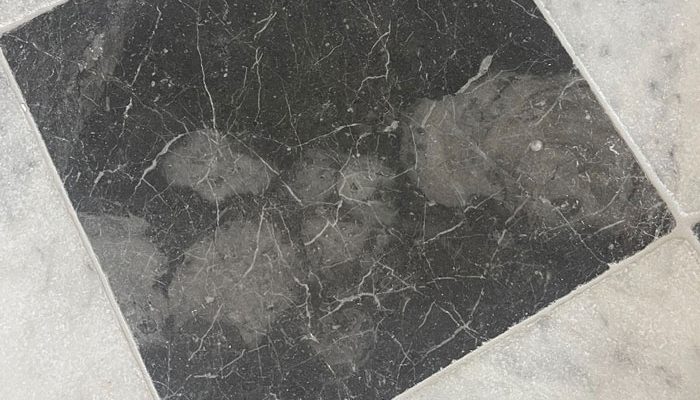
There is nothing better than the beauty of a real marble surface. Not only is it absolutely gorgeous, but it is also very durable. The problem is that not everyone knows that natural stone – and marble in particular – is sensitive to acids. Additionally, some of today’s marble-look porcelain tiles are highly authentic, so the two can be easily confused and the wrong maintenance products may be used.
A specific case
A few years ago we were asked to visit a fabulous residential property in central London. A finely veined marble, mechanically polished to a high shine, was installed in a humid room. The cost of the marble and installation had been around £10,000 at the time, probably much more now. An all-purpose kitchen and bathroom cleaning spray had been applied to the top of the wall and allowed to drip onto the brown marble surface. On a porcelain or marble-effect ceramic surface, this probably wouldn’t cause too many problems. But the highly acidic solution caused a chemical etch and significantly damaged the entire marble wall. Ironically, the product that caused the damage cost only 64 cents. A concentrated, pH-neutral detergent wouldn’t have cost much more.

How to restore a stone scratched or damaged by acid?
We recommend a three-step process, where the stone is lightly etched across the entire surface to uniform the appearance. It is subsequently neutralized and finally a reviving impregnator is applied to restore the natural depth. This process can be applied to all types of natural stoneincluding the tables of marblegranite and limestone, bathroom and kitchen floors.
It should be noted that acid damage is not just caused by cleaning products. Other acidic liquids such as tea, coffee, wine, vinegar, lemon, ammonia, tannins and cosmetics can have the same effect. You should also pay attention to «eco-friendly» cleaning sprays, as many of them contain natural acids.
Renovation in three phases
Phase I
First we apply LTP Remove cement, mortar and salt residues. This treatment removes residues and lightly etches the stone. Normally it should only be used on raw natural stone, but in this case it is applied to uniform the appearance. The treatment is formulated with a solution that replaces the acid, making it safe to use in this situation. Products containing hydrochloric acid should never be used as they will cause further damage to stone and metal elements, as well as toxic emissions.
First, the solution is diluted 1:1 with cold water and carefully applied to each plate, avoiding overlaps. The surface is then immediately rubbed with a black emulsifying pad. Care must be taken not to step on the floor tiles during this process. After application, the surface should be immediately rinsed twice with cold water and a clean sponge. Then, let it dry completely.
Phase II
To neutralize the stone, we recommend LTPGrimex. It is diluted 1:3 with cold water, applied to the surface and left to act for 15 minutes. Subsequently, the tiles and joints are rubbed with a white emulsifying pad and the residue is removed with a sponge or vacuum cleaner. The surface is then rinsed a second time with clean water to eliminate any remaining traces. Finally, the tiles are left to dry completely.
Phase III
At this stage a reviving sealant is applied to restore the natural depth of the stone. Recommendations LTP color intensifier. It is applied evenly with an applicator and left to dry naturally. After 45 minutes the tiles are polished with a microfibre cloth.
After applying the treatment, the boards should be left to dry at least for a while 12 hours before being walked on and must not come into contact with water three days. Also, during the entire restoration process, the underfloor heating system should not be turned on.
This process will help restore the surface of the stone and prevent further deterioration, maintaining the elegant and refined appearance of the marble, granite or limestone.
In future, stone slabs should always be cleaned with a mild, pH-neutral detergent. Recommendations LTP Wax wash for floors and LTP Stonewash for coverings. Both products clean deeply while protecting the newly applied sealant.
A regular cleaning regime will facilitate long-term maintenance and preserve the aesthetic appearance of the stone. Most stone surfaces will benefit from a wet cleaning of approx once a week.
Write a few words, your advice is also useful to others. There are currently no comments or questions about the article.
latest posts published
Elegance and versatility for your table
Plant shelf: transform your interior!

creative tips for your stay
Comfort and style at home
mix styles and dishes!

Transform your interiors with elegant pastel colors

Give a unique Boncoeurs gift

Olfactory elegance: reinvent your interiors

Brighten up your windowless space: effective tips